
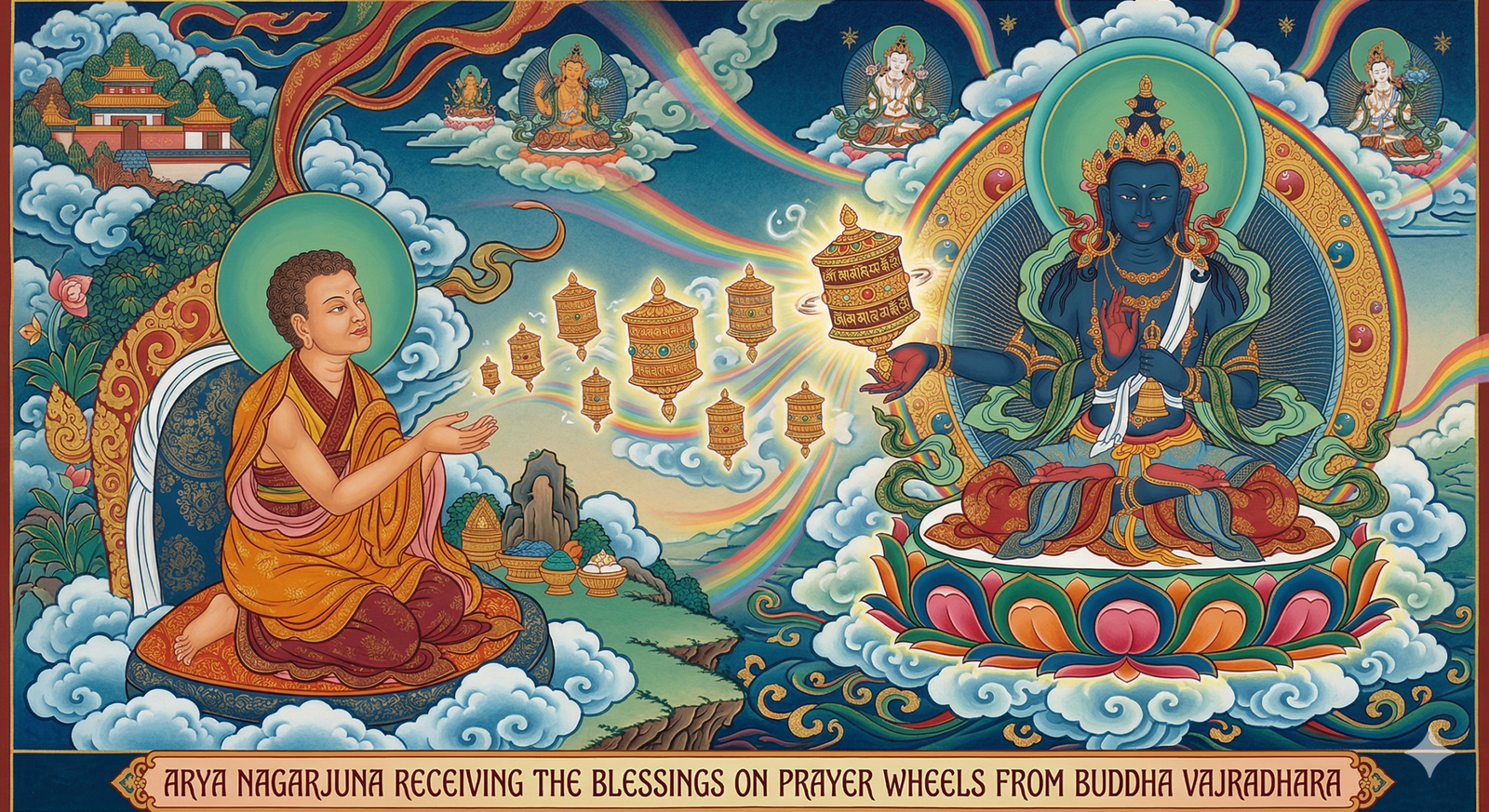
Prayer wheels are cylindrical objects made of metal, stone, or wood, mounted on a spindle to rotate without friction. They are spiritual objects printed with mantras written on them to aid religious practices and prayers to bring positivity. A Buddhist prayer wheel is an integral part of Tibetan Buddhism, and with this blog, I will walk you through its essence.
Origin Story of Buddhist Prayer Wheels
According to Tibetan Buddhism, the Indian philosopher Arya Nagarjuna (c. 150–250 CE) received the blessings and teachings of using prayer wheels from the supreme primordial Buddha Vajradhara.
The celestial being chose Nagarjuna to spread the powerful spiritual practice of rotating prayer wheels to the mortals in the human realm.
The teachings were transmitted by master translators known as Lotsawa to record and protect divine teachings. This is how prayer wheels became an integral part of Tibetan Buddhism and spread across the Himalayan region, Nepal, and Tibet.
Early prayer wheels were handheld, tiny objects crafted for individual practices. As more devotees started understanding the essence, the prayer wheels evolved in different forms.
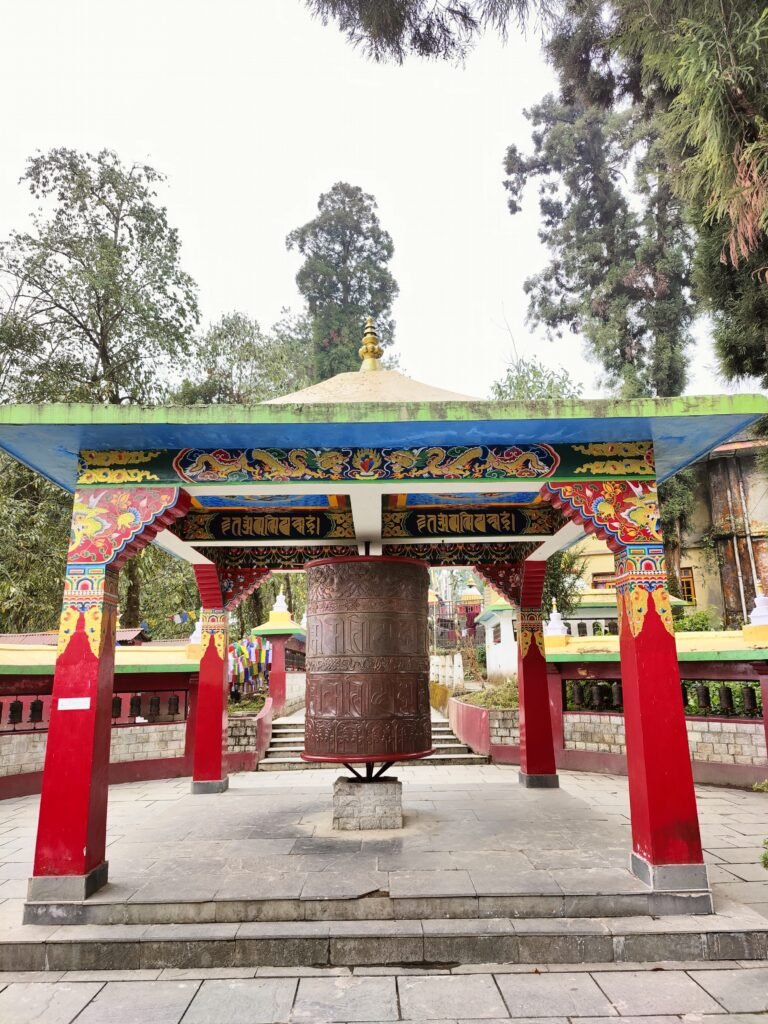
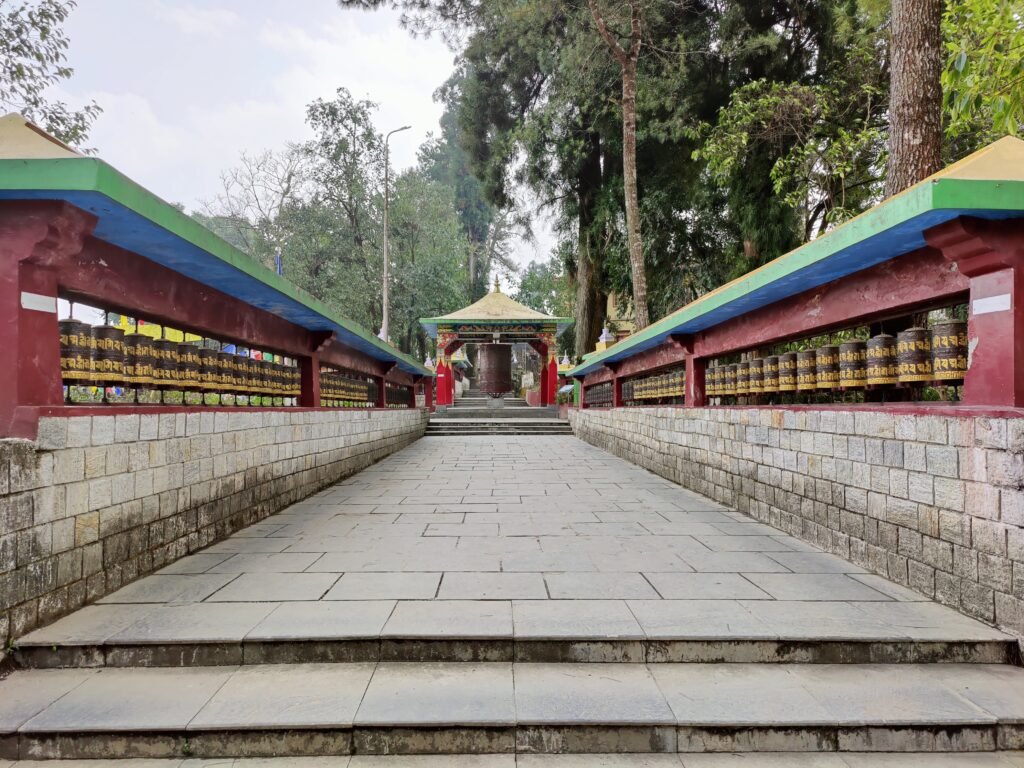
In Sikkim, I saw prayer wheels in monasteries, hotels, stupas, and shops selling souvenirs. Enchey Monastery has a large prayer wheel right at the entrance with stairs lined with smaller ones. Devotees spin them one by one as they walk towards the sacred place. It is believed that this activity is equal to saying mantras written on them to release blessings.
How does a Buddhist prayer wheel work?
Religions across the world use objects to aid spiritual practices. Like Roman Catholics use rosaries, Hindus use a japa mala, Tibetan Buddhists use prayer wheels for mantra chanting and praying.
The prayer wheels are made by adding sacred sutras associated with deities. The most common imprint on prayer wheels you would find when you travel would be the mantra of Avalokiteshvara, the Bodhisattva of Compassion. The mantra is “Om ManiPadme Hum”, which is also commonly seen in prayer flags across mountainous regions in India.
These mantras are inscribed onto the cylindrical part of the prayer wheel, and with each rotation, the prayers are invoked. Rotation is done based on the size of the wheel used. For example, handheld ones come with a stick, and large ones in monasteries are rotated by exerting upper body pressure. Many times, people come together to turn large wheels as they circle around it. It is a way of elevating collective consciousness to be one with the divine.
What are Buddhist prayer wheels used for?
Right when I was about to enter Enchey Monastery in Gangtok, I met a monk and asked him, “What are Buddhist prayer wheels used for?” He replied, “Shastra ka tantra likha hua hai.”
What he meant is that mantras and tantras from the Buddhist literature are imbibed on these prayer wheels. Further, he went on to explain that nobody wants to be sad in life. Everyone wants peace and happiness, and prayer wheels are used to invoke the same. It is believed that rotating these wheels frees us from our sins done life after life, as he said.
Well, there can be plenty of reasons why Buddhists use a prayer wheel, and it can depend on their individual goals. But one objective as to asking for forgiveness of sins is a common practice done by all.
Thubten Zopa Rinpoche had an interesting take on prayer wheels. He who dedicated his life towards preserving Mahayana Buddhism believed that Buddhas and Bodhisattvas manifest in prayer wheels to purify negative karmas and that the usage of these spiritual objects draws people closer to the path to enlightenment.
Spinning of wheels inscribed with mantras is equivalent to chanting faster than words can spill. Prayers are thus multiplied with every spin, and it is said that the wind around a wheel is purified through the action. The most crucial part is to have a calm and concentrated mind that focuses on the spiritual activity.
Symbolic meaning of Buddhist Prayer Wheel
Prayer wheels primarily signify the cycle of life or samsara. In Buddhism, wheels are highly revered as they represent Buddha’s teachings that take one towards enlightenment.
The prayer wheels are spun clockwise in alignment with the movement of the sun. The sacred mantras written on the wheels are inscribed in the Tibetan language in the same direction as the wheels are rotated.
The intent to use a prayer wheel is to cleanse oneself of negative thoughts and actions, create positive energy around, and send out healing vibrations. It is an object that helps practitioners connect with the frequency of the universe to bring peace inwards and around.
It is, however, important to note that every mantra has a different meaning, is a prayer sent towards a certain deity, and can have a distinctive impact. Buddhism is much wider than praying to the concept of Lord Buddha, which one can only decipher when they draw closer to the religion.
Types of Buddhist Prayer Wheels
There are different types of prayer wheels used in Buddhism. Here’s how you can find one too:
Handheld prayer wheels
Handheld prayer wheels are commonly found in souvenir shops in mountainous regions where there Buddhists population exists. They are tiny and portable, cylindrical in structure, and mounted on a stick. They are either made of metal, wood, or a combination of both, keeping the cylindrical part of metal mounted on a wooden stick. These come with a small chain attached on top for seamless spinning.
Installed prayer wheels
Large wheels vertically installed in monasteries in designated areas for practitioners to pray during their visit to holy places. These can be of different sizes, usually made of metal or wood. The energy of a spiritual place must always be highly elevated, and prayer wheels at monasteries do just that.
Table prayer wheel
Tiny prayer wheels kept at altars or work desks are mounted on a metal piece to balance the cylindrical structure. These are often used as decoration, meditation, bought for gifting, and more. One can use their hands and fingers to rotate the wheels instead of clenching onto a stick like the handheld ones.
How to use a Buddhist prayer wheel?
A prayer wheel has to be rotated clockwise and in the same direction as the mantras are written all over the cylindrical body. So, when using a handheld or table prayer wheel, you have to check in which direction the mantras are written and then rotate them clockwise.
While entering Enchey Monastery, we asked the monk we spoke to how to spin the wheel. He told us to use our right hand in a circular motion to make the wheel rotate. We also saw visitors rotate one wheel after another as they were stepping up stair by stair making all the wheels rotate as one after another.
Food for thought!
It is important to understand that an object we buy as a showpiece to keep at home or a souvenir to gift someone is an integral part of Buddhist religion. We must at best be respectful towards what it means and honor it by taking care of the product we purchase. If you want to start using a prayer wheel for meditation, I would highly recommend connecting with a guru for guidance.
Frequently asked questions (FAQs)
1. What is a prayer wheel?
A prayer wheel is a cylindrical object inscribed with mantras, sutras, and dharanis to be spun as an act of chanting and praying.
2. What are Buddhist prayer wheels used for?
Buddhist prayer wheels are used to ward off negative thoughts and actions and invoke positivity.
3. What is written in prayer wheels?
Most commonly found prayer wheels in Buddhism have the mantra “Om Mani Padme Hum” written on them. It means “hail the jewel in the lotus.”
4. Can non-Buddhists use a prayer wheel?
Yes! Buddhist prayer wheels are not exclusive to people born into this religion. However, it is a tool that must be treated with respect and used under guidance.


0 Comments